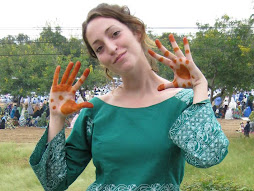
Tuesday, February 26, 2008

Twoudinò: gettin rural

I realized I never wrote about my trip into Haiti boonies! Most of this I wrote right after our return in mid-January…

I spent most of last week in a place called Twoudinò. For the non-Creole speakers among us (oh wait, that’s everyone) that translates to Hole of the North!! It is a lovely hole indeed, about an hour's drive from Cap Haitian, inland from the northern coast. I went to make house visits with the project director Fonkoze's program Chemen Lavi Miyò, or Path to a Better Life.

Watching the program in action was so interesting. I wasn’t contributing much of anything on this trip except a LOT of questions and the inevitable attention of being the token blan. Oh! But I graduated from Blan! to Blan WO! That’s TALL whitey! Are people that much shorter in the provinces that I stand out so much more?! Also in the funny whitey category, at one house where we’d stopped a girl of about 9 was inspecting my leg. My pants were rolled to the knees. After touching my skin she informed me that “if you were to get cut, they wouldn’t be able to sew you back together cause you skin’s so fine.” And my hair got stroked a few times. But aside from bringing entertainment to rural Haiti, I went on this trip to see Fonkoze’s work in the field, and to understand what the rural poverty of Haiti looks like.

We based our trip out of Twoudinò, but each day would drive 40+ minutes in some direction, on dirt roads (roads?) over streams, through ruts, up mid hills where I thought I’d have to get out and push... My favorite was when we would park, get out, and hike. Gauthier the project director, Shaila our pro from Bangladesh, and I zigzagging across wide open fields with nothing but the bald mountains in the background. I would have never seen these gorgeous countrysides and lost mountain panoramas if it weren’t for working with Fonkoze.

One thing Gauthier told me that was eye-opening was that many urban Haitians don’t even realize the conditions of the rural poor. I had assumed though that most Haitians usually had a relative or two living out in the provinces. Gauthier responded no, many people in Twoudinò don’t realize what it’s like right outside their own town. That was reinforced when my co-worker back in central office accounting, a 32 year old guy, said “My family is from Jacmel. I’ve never been anywhere but Port-au-Prince and Jacmel.” I was surprised—never a quick trip up north? No curiosity to see your country—national parks, revolutionary monuments? Haitian history is so rich!! But when I think of the roads and arduous stickiness of public transportation, I understand the lack of movement. But the conversation with the co-worker is also a reminder of Haitian incomes—working at Fonkoze will not make you rich and readily mobile.

And then the people we met, the women participating in Chemen Lavi Miyò.

I’ve heard the stories but the greatest effect of this trip was to have images—in 3D—to associate with statistics. To give you a feel for the average woman we visited: those who qualify to be in this program are the poorest of the poor. They’ve been identified by their community leaders. Fonkoze also has a poverty scorecard—the participants answer a set of questions in order for us to get a basic idea of the depth of their poverty. Most of these women can’t read or write, have 5, 6… 9 kids who aren’t attending school. They have no assets—land, donkey, nothing. Some have a husband. Their houses are typically made of sticks weaved together, with mud plastered against them to form walls. Dirt floors, thatch roof, or tin if they are lucky. No toilet—go poop in a field somewhere. Maybe a mattress, that a few of the family members can sleep on, the rest get the floor. Usually a separate little shelter of sticks and thatch under which they cook. A lot of the houses leak—if it rains, the family is standing up in a corner all night not to get wet. Nearest source of drinkable water… depends. And if you run out… it’s dehydration or dysentery, when nasty water is often the only substitute.

(For those not interested in micro-finance-y things, please skip following paragraph.)

Our program is funded by an arm of the World Bank, which is also funding similar programs in Ethiopia, Pakistan, India and Yemen. The intent is to replicate a program that was pioneered and met huge success in Bangladesh, where much of the work in microfinance began. We give these women some basic assets (they choose between goats, chicken, and merchandise to sell), and we get them in some of Fonkoze’s educational programs (basic literacy, sex ed.) They receive bi-weekly visits from their case manager to make sure they are on track, as well as a small weekly stipend so they can spend time tending to their assets/businesses instead of begging. Fonkoze provides a minimal amount of building materials (tin and concrete) to create a more livable/healthy shelter, and we’ve partnered with other NGOs (Partners in Health included) to get free health care for the women and their families. The goal is that at the end of the 18 months of this program, they can “graduate” up to the smallest of one of our loans (about $20 USD) to continue to grow their businesses, and provide for their families.

The two women I remember most vividly were some of the worst off. In one instance, the woman’s hut had collapsed. So she and her family moved into their goat pen. It was about the size of my bathroom, 5’ x 7’ and like most of the huts we saw, was divided into two miniscule rooms. A front area is where your dishes etc are kept, and a back area is for sleeping. I really have no idea how the whole family fit inside to sleep. The goats found a tree to sleep under.

The other woman who stands out in my mind had a lean-to shelter of one room, made of sticks. I had to crouch down to fit “inside.” Literally, there was hardly even room on the dirt floor for her 6 kids to sleep. The few clothes she owned for herself and the kids were hanging from parts of the sticks poking out of the wall. They’re only “inside” to sleep, the rest of the day is spent outside. She had no husband, and was rail thin, as most of the women were. Through her threadbare and holey white tank top you could see sagging breasts to her wasteline, although she was probably only 30 years old. Arms thin but strong and muscular. Hair in a few chunky braids, as was typical of all the women we saw. Before the program, I’m pretty certain she’d been begging on a nearby road, and probably still does some. She had begun planting a few random crops in her yard, and her new goats were nosing around the yard. As bad off as she was, she was one of the more lively of the women. I liked her cause she poked fun at Gauthier for having “so many women,” …all of the program participants!

A final woman I remember was, along with another program participant, planting peas in her mother’s field when we walked up. The woman was about 70 and her mother is still kicking at 104!! Under the shade of a nearby tree, the 70-year old and two other Haitian women squatted down on their heels in the dust, to talk to us. I know very few American women limber enough to manage this classic Haitian squat that these women do EVERYwhere!! It was in observing these women that I couldn’t help but think, the poorer they are, the more beautiful they are. Haitian men look alright, but the women… just blow me away. Watching her as she talked, I could hardly look away from the 70-yr. old, she was so stunningly put together. It wasn’t til I was really staring that I started to figure what makes these women so attractive… after having wondered about this for months! The high defined cheekbones—it’s all there! Their faces are just set beautifully, with broad and proportionate noses, and skin that hardly seems to age.

Coming home I was left with plenty thoughts, ideas, and hillside conversations to chew on… which I hope I don’t swallow and forget too quickly.


From the photo album:

Me and Shaila, sitting on the bed we shared, in the house of one of the local employees. His wife also cooked our dinners! (Shwanky hotel days and per diems courtesy the USG are OVER!! )

My teammates, Gauthier the project director, and Shaila, our pro on loan from the Bangladeshi microfinance institute who pioneered this program. They're hugely knowledgeable... and kept me well-entertained to boot!

Friday, February 8, 2008

Brazil in Color!

Back from Brazil!! Getting my head back to Haiti is hard! Brazil was beautiful, easy to get around, and I never got stared out for being the only blan!! So much I could say, but might be easy to show you some of the craziness in color.

My first Saturday there:

Walking on Copacabana beach with Ricardo and the Janes family we came upon some interesting artwork!

We arrived at a massive street parade in Ipanema. It was one of my favorite days there—the people, bustle, learning some new dance moves on the beach courtesy Ricardo (You can’t come to Brazil and not learn how to samba!) Ricardo bought the Brazil flag sarong off the sidewalk. Yes, I am wearing it! (Nobody knows I’m a gringa this way, right?!)


Dad, for your next costume?

The floats get political! No clue what they say though!

Beer-head dude!
I got to be good friends with these guys—the caipirinha vendors!! Their caipirinhas came in the classic lime, passion fruit and coconut. How could I not try all my fruits and vegetables? :)


Looking in the direction of Copacabana

Sunday:

We went to a soccer game at Maracana stadium, one of the biggest stadiums in the world, which held the South American Cup in 2007. We rooted for the local team Flamengo. It’s only tourists who AREN’T wearing the jerseys. So we each bought some a sweet cheap headbands instead. This in turn bought us a LOT of friends! Ricardo, me and Nick.

Fans go nuts

Can I take some Brazilian kids home with me?!

Later that night—still so easy to make friends when you choose the right team!! Check the dudes shirt on the right :)
After the game we went to the Sambadrome. This is where THE Carnaval parades happen, the Monday and Tuesday nights, starting about 9pm, done by about 4am. The twenty samba schools in Rio each parade through. (The samba school is the equivalent of a Krewe in Louisiana. Except they can all dance!) Rich foreigners pay $700 for a ticket to the Carnival day parades, but you can watch the practice sessions for free! They don’t have the massive costumes and floats, but plenty of energy and music!

Parade turning into the Sambadrome. It’s probably 300m long, and the width of a highway, used specifically for the Carnaval parades!

Monday:

Bike riding in the misty rain around the lagoon of Rio, Ricardo took this action shot from his bike!! (That’s coordination!) By the way, I should credit Ricardo with almost ALL these photos—I hate taking pictures!

That evening before dinner we heard mad drumming, and wandered into the thick of a drum school’s rehearsal—amazing. Deafening, but entrancing. I can’t wait to learn some myself!


Out for dinner that night at a traditional resto of the style in the Northeast region, Bahia.

Wednesday:

We went on the favela tour. It was fascinating. Of course I’m going to compare it to Haiti. My first thoughts—this is a slum?! But you have businesses here!! In Haiti it’s tin lean-to after tin lean-to and a handful of informal businesses/street vendors in site. So Rio surprised me a bit. Clothing stores, butchers? Electricity?! Garbage pick-up?! (Just bring it to the bottom of the hill.) The favelas are all on hillsides, the areas where the rich people didn’t want to settle. The police don’t go there either, except for drug raids, which often end violently. You can literally see the borderline of the favela neighborhoods—it’s where the cop cars are parked, waiting. There are more than 700 favelas in Rio—varying mostly by who settled them and when. Very very few appear on an official city map. That would require the government of Rio to recognize them, install a police office there, and provide more services.

The first little bitty favela we saw was—according to our guide—probably one of the only in Rio that DOESN'T have drug gangs. Why? Because wealthy folks built a golf course behind the favela with a huge tall wall in between the two. This and a mountain limit the favela, and would give a drug lord no place to run and hide when the cops come. Very interesting. Otherwise, favelas and drugs-and-guns seem synonymous.

This photo gives an idea of the close quarters and houses on top of houses. (This is what much of Port au Prince looks like…) This is the small favela we visited, Villa Canoas, which has only about 3,000 people.


A street in a favela—not wide enough for more than one person.

This place has benefited a lot from a recent government initiative—bright- colored paint jobs, putting cement stairs over mud pathways, tiles for the houses—it was pretty in places!!

Ice cream in the favela—wow!! In Haiti’s slums you find mud pies for sale.

Rocinha, the other favela we toured, is one of Rio’s largest. More than 100,000 people live there. Within Rocinha is every service you could need—you could live here and never leave. It’s also literally across the highway from one of Rio’s wealthiest neighborhoods. You are never far from a favela in Rio.


Wednesday night:

A sweet local bar we wandered into in Copacabana! Copacabana neighborhood actually has the highest per capita of senior citizens in the city—all the folks who fell in love with the city in the 50’s and never left! So grannies everywhere. But still, a neighborhood bar on EVERY corner with friendly locals!

Goofing off on Copacabana beach!


Thursday:

We went up to some touristy sites—Pao Acucar, or Sugarloaf Mountain.

Copacabana in passing:

Soooo cloudy on Sugarloaf, surrounded in white like we were in heaven (thus angelic poses :)

When the clouds leave! View from the top of Sugarloaf—THAT’s the cable car used in some James Bond movie for a crazy fight scene between James and a dude who’s got a bunch of metal in his mouth!!

The Loaf!

From another site near the big Christ Redeemer Statue

Speaking of Christ—we didn’t hang out with him up close—he was a bit busy with the clouds. The Christ Redeemer statue is pretty much the landmark of Rio. You can see him from almost ANYWHERE in the city—kinda like Big Brother watching over!

Historic neighborhood Santa Teresa

Historic fruit vendor explaining to some other tourist why they’re not allowed to take pictures, while Ricardo takes picture.

We took a capoeira class that night—and it about killed us!!! All four of us we sore for at least 2 full days afterwards. I still have the blister. I LOVED it. That’s our instructor, who spoke NO English. But—my Portuguese vocabulary now includes Iiiiisso (thaaaat’s it) and Naaaaooooo (haha—no!) Saturday:

Another block parade in a different smaller neighborhood, Botafogo:

Graffiti! (I’m an elephant.)

Your average Brazilians in tutu

The most unflattering picture of me this trip. BUT, I couldn’t believe a fat stick of meat cost 2 Reais—US $1.30! That’s the same price for a can of beer (also exhibited in this photo)!

Cute kids everywhere. Put him in my pocket.

While Alfonso here on the left worked tirelessly throughout the afternoon to smoosh limes into delicious caipirinhas, his colleague on the right who handled the money took the liberty of an occasional break to play his cymbals!!

A last highlight not captured on film:

Saturday, my last night there we indulged in a rodizio churrascaria around the corner. The Churrascaria is the typical Brazilian method of sitting at the table while the waiters come around with meaaaaat after different type of meat, skewered on sticks, which they slice directly onto your plate. Rodizio means all you can eat. BUT unlike churrascarias I’d been to before, where the waiters have a respectful and cautious pace, these waiters came about once a minute to give us meat!! I have never in my life gone from feeling hungry to about to pop in less time.

We went home and took a two hour nap (that was an accident actually!) before going out for the evening. It was my last night in Rio, and I was determined to brave the over-stuffed belly, post-capoeira soreness that made us all walk like ducks, and MORE rain! Worth it. Streets were packed in the old historic district we went to. The night turned into samba dancing in the rain, and when we were finally ready to head home, we stumbled across… another practice parade!! We’d heard drumming in the distance and followed it. It was about 3:30 in the morning. The samba schools had on their FULL costumes—we even saw all the ENORMOUS floats, mostly wrapped up to protect them from the rain, but making their way to the Sambadrome. No other tourists in site! The parade was through the downtown business district that I hadn’t seen yet, and it totally took me in to see Rio’s contrasts so sharply outlined there. All the homeless people huddled under the rain in the skyscraper doorways, trying to sleep through the pounding and pervasive drumming representing Rio’s best moments of excess.

When we returned home about 6:45 that morning:


We hit a last parade before my flight out Sunday night—I was nervous I wouldn’t be fully sober arriving at the airport—a super end to my adventure! In the taxi on my way to the airport, it was a clear night, and I could even see Jesus perfectly lit up on the hill.

Getting back to Port au Prince—time for more Carnival, but some serious detox. :) Rio was an incredible opportunity and I’m hugely grateful to Ricardo and all his Portuguese skills and to Nick and his lovely family, the Janes, who let me stay with them!

PS--If you want to see any of the pictures in a larger view, just double click them.

Friday, February 1, 2008

Brazil Brazil

Bom dia from Brazil!


So far it´s lovely here. The people are incredibly warm, dressed in bright colors always (oh wait, that looks good when you have a perma-tan!!) Even the fruits and food and juices are colorful--pinks and oranges and all shades in between!


I got a great initial dose of the Carnival activities. Not long after arriving, I met up with my hosts, friends Ricardo and Nick from DC, and Nick´s family, with whom we´re staying smack in the middle of COPACABANA. We made it toward a parade with bands playing, streamers waving, people dancing in ways I´ve never seen (it´s called samba!) and the caparinhas FLOWING!! This is decidedly one of my favorite drinks of all time. So much so, that we bought the ingredients to make them at home today, and might just whip up a few upon returning from the current internet cafe! I came to Brazil with a slew of coffees and Haitian liquors and rums for my hosts, weighing down my bag. Looks like that space might not be empty on the return trip home, as planned! Just substitute one country´s sugarcane liquor for anothers! (In Brazil it´s called CICHAÇA!)


We´ve had some great food so far--combinations of pumkin, cheeses and meats, and lots of little tidbits off the side of the road--local Brazilian pastries stuffed with cheeses and... more meats. Vegetarianism did get left behind in the ``developed`` world. There´s a fruit here called acai that is amazing--bright purple, that makes a thick juice I drink in large doses. Also today at an outdoor market, stopped at a stand where workers put the sugar cane through a machine, and the sweet juice is squeezed out on the spot, garnished with a splash of lime, and handed to you. (My mom does always say that in Louisiana, people don´t ask you what you saw on vacation, but what you ate! End of food report!)


In terms of sights, I´m headed to a favela tomorrow. Those are the NOTORIOUS slums of Rio, and we´ve had tips on local guides that offer well-reputed tours. It can be a sensitive subject--who is benefitting from tourists´ looking at local folks´poverty? But the tour operator apparently reinvests the money into a local school. (Check out the movie City of God-- a really well-done movie that depicts life in the favelas.) I´m very curious to see the questions of infrastructure and community services available, and how that compares to the city of Rio as a whole. Brazil has one of the greatest income disparities in the world and the favelas, ruled by the drug lords, are never far from the frothy posh upperclass neighborhoods. The struggles of these neighborhoods won´t go away by ignoring them. I´ve seen them in the slums of Haiti and I´m curious to see how the history, problems, and proposed solutions differ in Brazil.


In the TO DO category--there´s been plenty exploring of neighborhoods, bike riding around a local lake, and I hope to go for a hike in a forest that is WITHIN the city of Rio--how cool is that? The guys and I are taking a capoeira class tomorrow. Capeoira is a totally one-of-a-kind martial art. It was developed by the slaves of Brazil to fight against their masters, and was disguised to look like dancing. It´s obviously endured long after slavery was abolished in 1888. Its very fluid motions, done to music, almost looks like a performance--but don´t relax--or you will get KNOCKED out!


A last note before I get kicked on out--Brazil is AMAZING in terms of racial diversity and integration. I wish everyone could see here the zillion different shades of people that walk and work side by side. Every one kind of ends up... beige! True--the Afro-Brazilians fight some of the same issues of poverty, acess to education and opportunities as in the states, and the favelas are more often composed of the Afro-Brazilian population. But racism seems markedly less. To see a couple that is actually the same color seems more rare than seeing ``mixed`` couples.

Still more music, neighborhoods and beaches to discover!
Plenty love to all,
K :)

Saturday, January 19, 2008

Petite Annonce

January 17, 2008, 12:30 am
Wayyy past my Haiti bedtime.

I’m sitting at my computer with 24 internet browser windows open. That’s what you do when you have no clue when your internet is going to cut off and you just found out where you’re potentially going to spend the next 2 + years of your life.

I got my Peace Corps assignment.

I was waiting for the e-mail in my box. Earlier today I’d had my heart-to-heart phone call with my Peace Corps placement officer, while sitting outside on the front steps of Fonkoze, the Director looking for a budget from me. I'd been nervous about the call for most of the week. I cajoled the placement officer into believing that I’m ready to give up a few details of Americana in the big move. She was ultimately quite satisfied and told me she'd send my official invitation (the country assignment!) by snail mail today. Since patience is no strong suit of mine, I negotiated for e-mail and instant gratification instead. When I saw her message tonight, before opening it I tried to give myself a last reassuring pep talk that I could handle and be successful in any country… but instead tore straight into the e-mail.

So the pieces fall together. A dear friend from Clemson there, a New York Times write-up on it, a friend of the family who ended his service there and is violently opposed to the program. The cherry on this sundae of Africana: my next door neighbors here in Haiti—yep, they’re from there too.

It’s the furthest I could possibly be from Louisiana—in both latitude and longitude, hardly even in West Africa. Not even fully French! Part former British, former French colony. There was more than a 50% chance my assigned country would be one in which MCC (my former employer in days of Washington glory) works. Nope. So I’m pushed out of the minimal comfort zone I’d developed in my mind. Good—I won’t be anyone special and I’ll have the typical and classic PC experience. (I would have been sooooo well connected in Mali.)


Loo loo loo loo looooo :) (little typewriter noise)


Here’s a hint. It starts with a C and ends with an Ameroon!!!


I’m assigned to Cameroon!!!!!
Whewwwwwwwwwww!

Now I actually have to decide upon, confirm, and accept my invitation. I plan to say yes after a few more questions to the placement officer to at least hold my spot. This is exactly what I needed to know before I started any serious discussion about a potential permanent employment with Fonkoze! Time to go to Brazil!!!

(Yes, I am skipping off to Brazil for 10 days. :) I have to make up for having missed Mardi Gras every year since I left Louisiana at age 18. So I get two Carnivals this year: Rio de Janeiro + Port-au-Prince! I should mention I have friends traveling there, one native Portuguese speaking, and a place to stay!! Yippee to making major life decisions on a beach!!)


*****
January 21, 2007

PS - I had my first taste of Haitian Carnival last night--WHOA!! Five minutes from my house, still more than two weeks away from Mardi Gras, this place makes New Orleans Mardi Gras look a semi-civilized town-hall meeting. Streets are PACKED! The music is so loud it shakes the windows of my house and makes my internal organs rattle--no lie--like an unrequested deep-tissue massage. And only two no-thankyou-I-really-don't-know-how-to-dance-like-a-Haitian speeches (more like lots of gesticulating and YELLING!!)

Friday, January 18, 2008

Stats 101: extremely methodological

Haiti statistics for the curious

- Number of get-out-of-the-way-or-be-a-pancake honks per ten minutes of walking on a Haitian road: 10

- Average # of tablespoons of peanut butter I eat a day: 4 -5 big ones. It’s REALLY good here!

- Number of times I wash my hair per week: ‘bout 2 (I still brush and floss teeth regularly!)

- Average age to start sending kid to school: probably about 3, or the Haitians are just stunted and TINY! (If you can afford school, send ‘em as soon as possible before $ runs out cause it’s not free in Haiti.) If you can walk, you go to school!

- Average cost for box of imported healthy bran cereal: 6 + US dollars

- Cost for a mug of coffee off the street: 14 cents

- Cost for 1 pint olive oil: $10

- Cost for a gallon of gas: about $6

- Cost for roughly a gallon of milk (imported in BOXES from FRANCE!) : > $6 (I’ve taken to the powdered stuff—not bad!)

- Cost for a bottle of good Argentine red wine: < $4 (yay!!!)

- Number of spray bottles of deet I consume per month: 3/4

- Number of cell phone card vendors per 10 minute walk outside in Port-au-Prince: 5

- Age I probably resemble when I speak Creole: about 6 by now! And this is how I request technical accounting procedures…nice!

- Cost of a can of black beans (available at most American groceries for 59 cents): $2

- Cost for a bag of uncooked black beans that will make a LOT of beans, and make me feel smart and economical: < $1

- Number of times I have successfully cooked the cheap black beans: 0/2

(The first bean bake fiasco almost resulted in burning down my apartment in Paris. Tonight was a close call deja-vu. And this is after I specifically asked my mother how to avoid another Paris incident. What is it about me and black beans abroad?!! Tomorrow night: Garbanzos!!)

Yes, I did used to work at Census Bureau, source of all things statistical. Can you tell?!

Saturday, January 12, 2008

Peace Corps and Mauritania Madness

Wow! Check out this article by the former head of the Peace Corps for Cameroon. Interesting and valid. Makes me refine my answer to the question (for the 37th time!) just what is it I want to get out of Peace Corps, and in tandem, what do I hope to contribute?

http://www.nytimes.com/2008/01/09/opinion/09strauss.html?_r=2&oref=slogin&oref=slogin

All this said, I read this article within 5 minutes of hearing from a dear friend who just finished her 2 years of PC, also in Cameroon. She just opted to extend her time there for a third year in their health programs. I think the experience is what you make of a realistic set of expectations. A combination of optimistic altruism and accepting the fact that you may leave no tangible or lasting effects. I’m old enough to know I’m not going to save the world… but hope to contribute to a little corner of it.

The Peace Corps placement officer (responsible for picking the country where I would potentially spend the next 2+ years) is currently DRILLING me on why I don’t want to go to Mauritania! Whatever happened to Just Say No and leave it at that? Damn. That is my sole request! Quota filling? I don’t want to go there because it’s probably the most Muslim of the West African countries I could end up in, and it’s almost entirely rural. No even moderately bustling capital where I could hope to find more progressive views on women! I told Peace Corps from the get-go that I don’t want to go to a place where I won’t be taken seriously as a woman. In Jordan, for example, women volunteers in some places cannot leave their houses without a male escort. If a woman is not capable of walking alone in the street, how would she possibly be considered capable of running an organization, managing a project, or just making decisions? I don’t want to go where my gender will cause me to be less effective.

A little more entertainment for ya! This article sure left its impact on me. Fatty in Mauritania: http://www.nytimes.com/2007/07/04/world/africa/04mauritania.html?scp=1&sq=mauritania+fat

(If you're not registered for NYT... parents, just do it so you can read this article.)


I also told the PC placement officer (I had limited internet, had to respond fast, and just went with straight honesty!) that my athletic involvement is synonymous with community involvement. It’s true. I made friends and contacts, and sure learned more about France and the French when I played on my university’s rugby team there! I told PC it would be a waste to both me and the Peace Corps if they sent me to a place where there was no way a girl could kick a ball/putter around on a field somewhere. I’m not asking to go to the Olympics, and am ready to make some serious lifestyle changes, as I already have in Haiti. But don’t send me somewhere where I have no hope of doing as much as twitching in public.

That said, my friend Charles talked to the soccer team of a local university here where he teaches and plays ball. They said I can play with them. :) I might be asking for a real wupping here—I’m not in running shape! Haitians are also intense on the soccer field—no call goes uncontested and passionate arm-flailing arguments are apparently the norm. It’ll be good for my Creole. :)

Saturday, January 5, 2008

Fun with Pictures: Happy New Year!

A couple really cool things happened recently. So cool in fact, I took pictures!

The first was the chance to host an amiga Americana, Ellie, who was in Haiti for a few weeks researching. She was an awesome exploring buddy! The combination of her presence here + the tapering-off of peak kidnap season was a great chance to get out! She and I took the sardine taptaps, enjoyed lots of street food (pickleeeeees! plus a few other unidentified things that looked tasty and made for mostly pleasant surprises,) and haggled with the street art vendors, (which I’m not good at yet—too nice!) We walked from one side of Port au Prince literally across town to chez moi—about an hour and a half of pothole-dodging, winding through the hills! When we got home it hit me how incredibly liberating it was to just be outside and walk—I hadn’t realized it until I didn’t have it.

What I really appreciated about Ellie’s visit was bouncing ideas off of someone who has been in similar situations in rough countries, being the obvious minority assumed to have lots of money. When I first arrived here I aimed to lay low, keep my head down, go about my business. Hide myself away and hope no one noticed me. In talking with Ellie and meeting other blan Americans she knows here, I realize it’s ridiculous to think that everyone and their brother doesn’t already recognize me as the sole blan of the neighborhood, and know where I live, whether I know them or not. So why try and hide when I’d rather embrace being here. In reality, I think I am safer this way, as the Haitians watch out for those they know, those who are a part of their neighborhoods or lives, even if that’s just a smile and bonjou as you go past.


From Ellie’s visit:

Ellie with our feast of roadside food (I realize it does not look like a feast in this picture. We were hungry!) She helped me discover some great vendors right out my front door! My apt, and Haiti map in the background (courtesy my friends at MCC!)

Are those flags flying in the background?! No no, just my undies in the backyard.

My neighbor Lovelyn’s Christmas present, babydoll Lovena, sitting on my clean laundry. Even white dolls can have dreadlocks!

Lovelyn (with cornflake dribble on chin), mwen, Lovena (her clothes were reportedly dirty at the time), Ellie


Other cool event: Camping on the beach on the southern coast, over New Year’s/my birthday--really not much explanation needed! It was ideal. Ocean stars ocean stars ocean stars. And cremas! You can already see the stars here in Port au Prince, but looking out over the edge of the mini-cliff that was our campsite and into the night sky is almost addictive, where you can just stand lost in your thoughts for ages, with the sound of waves crashing below. A new year + a change of scenery spurs plenty contemplation. And the cremas. J It’s certainly one of my new Haiti favorites: sweetened condensed milk + rum + a few other magic ingredients is good—dangerously so :) Just don’t spill it all over your black pants like I did and get made fun of for it for the rest of the weekend! Or consider bringing more than one pair of pants! My cell phone was also a victim to the festivities—lost in the revelry. So if anyone calls me and a Haitian man answers instead, just wish him happy new year!

I got to swim everyday. I can’t say I’ve ever been surrounded by as much quiet as when I’d dive under the surface and towards the blue deep. It’s so incredibly peaceful (especially compared to the non-stop rara and music of downtown PAP!) Coming back up to the surface to break through to fresh air and blinding sun—feels like entering another world.

The people make all the difference in any good celebration, and I wasn’t let down. J The crowd at the campsite was mixed Haitian and American, from different places and backgrounds. Like in DC, in Haiti everyone has opinions on politics and progress—but the variety of attitudes is more marked here. I lit into the campsite owner when he said that all NGOs are in Haiti for the money, and the average Haitian’s poverty keeps the NGOs in business. There can be truth to that statement, but I won’t stand for a blanket stereotype of the sort of institution for which I moved here to work. (He’s pictured below showing his sense of humor…) All said, I found buddies for soccer-playing (yippee!), book-reading, and more explorations!

Camping Pics: Pooja and me at the campsite, eaaaaaarly into the long New Years night!

My friend Charles the well-dressed pirate.

… but I don’t think real pirates wear yellow. Just out of range of this pic is a 40 foot rock cliff I jumped off of… :)

The campsite owner, a Haitian dude, is at least as much of a character as my Uncle Chris.

A deep last thought: Spotted on a T-shirt at a roadside market en route to the South: CAMPING: A great excuse to eat beans and not shave.

Yeah!

Now I go into super-rural central Haiti most of next week with one of our projects—like camping for work! I’m really looking forward to it. And the beans :)

So happy 2008 to all my dear friends and family—I hope you find what you are seeking, or at least learn from the search.

~K