Tuesday, July 20, 2010

Peace Corps Blank

I’ve written many things that I’ve never posted on this blog. The entry below was one of them. I didn’t want to sound so impatient, so inflexible, so soon. So I let it sit, so I could come back to it two years later and see if my predictions were true, or if I’d become a better, gentler, more patient and generally more angelic person. It’s dated from November 2008, when I had been at post not yet three months…

November 2008

Several Peace Corps Volunteers have described to me a skill that they have acquired over the course of their two years in Cameroon—an ability to zone out, blank their minds, for hours at a time.

When you first hear this, it seems somewhat shocking. I can’t help but calculate my former hourly wage and ask, really? $XX lost simply gazing into space?

It’s a survival strategy—for dealing with tediously long bus rides too crammed to read, conversations where one insists on telling you a litany of things you are already know (tune back in just in time to laugh or nod, as appropriate), or six hour staff meetings. As one volunteer said to me, “My Cameroonian co-workers have to sit through the staff meeting too, so why shouldn’t I? That’s exactly how you understand how people have to live here—you wait with them. You share their stories, and their frustrations.” And I ask myself, because I happen to come from a culture where time is money, to what extent do I want to use that as an excuse to skip out on the awful moments of waiting?

This morning was a classic example. A 9am rendez-vous with the mayor of Mokolo. He shows up at about 11:30am. I’m trying my dangdest to sit in small-talk solidarity with my Cameroonian colleagues, but by around 11am, my impatience wins over, I break down, find a place to sit, and whip out my book. Reading is one of many things I’d rather do than… just sit. Solidarity takes a hit. Not everybody has a book to read.

To me, that Peace Corps zone-out seems dangerous. One volunteer who is preparing to return to the U.S. laughingly said to me that he’s worried about just how good he’s become at tuning out. I don’t want to tune people out. I want to believe that what they have to say is worthwhile, or that I could at least steer a conversation toward useful and relevant information. People have told me that my patience will build with time, but there is a part of me that laughs and thinks, they just don’t know me. Another part of me says, and why should I allow my patience to grow? So that I can better excuse the status quo? Although I realize that some adapting to the Cameroonian pace and culture will help me, I also think that a complacent acceptance of the status quo is not what this country needs. Complacent people have never changed things. To bring about some level of change, I think strong emotion—be it fear, grief, hope for something better, or maybe even a healthy dose of impatience—is necessary. So for the moment, I’m not yet going to blank out, stifle my impatience, or believe that my time is not worthwhile. Check back with me on that subject in two years!


And so now, July 2010.

I can’t help but laugh because… I was right. Self-fulfilling prophesy? Maybe. I’m no more patient than I ever was. But I know how to better deal with situations now. I know the things to say or the jokes to make that can help me get what I want and put everyone at ease. Yet, whether I’ve got the cool and composure to say what I’m supposed to, when I’m supposed to, is still another question. It’s so gratifying when it works. I make a joke that helps me get the price I want while bargaining in a market, or a knowing comment that generally convinces everyone that the nassara is not that much of a cold-hearted foreigner.

But it’s true—I still can’t and won’t do six-hour meetings. I will sometimes steer conversations toward what I think is useful, after I’ve gone through the minimal and required greetings and pleasantries. And maybe I’m missing out on something there—that which other people think is important—that’s what I’m here to learn, right? I’ll never be as patient and kind as some other Peace Corps Volunteers. But I’ve been lucky enough to collaborate and spend time with those volunteers, and they’ve taught me invaluable lessons. I think the key is to channel the impatience, the desire for change and for not settling, and to seek something useful out of it, instead of a festering frustration at the systems that create these situations. Some people are capable of blanking out. For better or for worse, I am not.

Truly, my closest Cameroonian friends are those that can and do work on more “American time,” who are busy, who don't like to settle. They fuss at me if I show up late for a meeting. An interesting anecdote. My best friend in town is Jacques. Last year we were out having a drink when he let slip that his birthday had just passed. “Jacques!” I said, “Why didn’t you tell me?! Your birthday! We would have celebrated! What did you do?!”
“I cried,” he responded. “Because I set certain goals for myself to have attained in that year, and they didn’t happen.” Jacques is one of so very few Cameroonians I know who would ever say that.

So what to do? Support and encourage the Jacques who are out there? Plant seeds, just show a different way of doing things? And what about the situations where I just have so little control, the waiting for mayors and other people deemed more important than I? Those are the moments, with quiet resignation, that I am grateful to return to America. I don’t know what to tell Cameroonians to do, as important people determine their future while they… wait. I’ve felt the frustration, and at times I’ve run from it, deemed it not worth my time and effort, but only in feeling the frustrations have I learned and understood, if only for a moment, the struggles of other people. I wish I could say I struggled and waited in solidarity at all times; I didn’t. I’m grateful I had the opportunities I did to learn, and I’m humbled that so many people here are so very much more patient, persevering, and determined than I am. Cameroon demands it—both for survival, and to make the changes we hope to see.

I’m grateful to a friend who recently sent me this quote. It’s the type of thing I need to tape to my wall, stick in my wallet, and keep in my heart as a reminder of who I want to be, as I forge on into other future work such as this, in places such as Cameroon. I leave you with this, from Teddy Roosevelt’s 1910 speech, entitled The Man in the Arena:

It is not the critic who counts; not the man who points out how the strong man stumbles, or where the doer of deeds could have done them better. The credit belongs to the man who is actually in the arena, whose face is marred by dust and sweat and blood; who strives valiantly; who errs, who comes short again and again, because there is no effort without error and shortcoming; but who does actually strive to do the deeds; who knows great enthusiasms, the great devotions; who spends himself in a worthy cause; who at the best knows in the end the triumph of high achievement, and who at the worst, if he fails, at least fails while daring greatly, so that his place shall never be with those cold and timid souls who neither know victory nor defeat.

Thursday, July 15, 2010

Two Years Later: White girl still strugglin to dance.

So Thea and I had a little going-away bash the other night. You really never know which way these things are going to go.

Mamoudou here, responsible father of seven and pillar of Mokolo's civil society, reported it was the first time he had drunk wine in ten years. I don’t know whether to be proud or concerned as I encourage my Cameroonian friends along the wayward path.


My parents did raise me to be classy.


I just like how happy our favorite moto driver, Sangenis, is here at the prospect of that boxed wine!


Somehow, the party evolved into a dance-off around a centerpiece of… a bowl of whiskey sachets. Interestingly, the accompanying music was provided by our friend Roger. He whipped out his guitar and played what he knew everyone could sing along to: Jesus music. And you don’t need to be Christian to know your Jesus music. I have some Muslim friends with great voices!


A little video of the sing-along:


Awkward white girl trying to dance. My partner here is Antoinette, Thea’s neighbor who never fails to boost my ego with her commentaries on my attire. When I showed up at Thea’s in a dress, she said, “Oh Fleurange, you’re pretty today!”
“Ah, Antoinette, I was ugly yesterday?”
“Yes, you were ugly yesterday.”


Keep trying!


Antoinette shows us how it’s done. Here, she has the entire bowl of whiskey sachets on her head.


I have so much to learn from her. :)


Illustrative: That is the whiskey sachet in action.


The after-after-party. Here, my postmate and dear friend of two years, Thea, shows us that unlike me, she has in fact learned to shake it.


Can I just add as a side note that a few nights later, at dinner at my house, I learned the traditional dances of the Mafa, Kapsiki, AND Toupouri peoples. Just wait til the next time you’ve got a drink in me. I might blow your mind with my all-new-yet-traditional African bush moves. :)

Sunday, July 11, 2010

I will miss

I leave Mokolo in only four days! Since my mama always taught me the value of pro and con lists, I couldn’t help but start noting all the little things I might (or might not!) miss when I leave Cameroon, for better and for worse…

I will miss:
• Random debates that break out among strangers in the middle of a shared taxi ride across town. And even when a consensus is reached, someone says, “Well now we’ve started arguing, we might as well keep arguing until we get to our destination!”
• Being able to lose my cool with somebody and then be best friends two seconds later.
• Wearing the same shirt a few days in a row. And wearing the same three ugly pairs of pants for two years straight.
• Wearing ridiculously loud pagne ensembles, with poofy sleeves, and being told I am beautiful, as opposed to, say, a freak.
• The freedom of my schedule: taking a nap, or a run… or a drink, on a weekday at 11am! Waking up with no alarm, working from home, and going in to an office specifically when I am needed, not just to punch time. Setting my own priorities.
• Gratuitous nose picking.
• 1$ beers. 20 cent whiskey sachets.
• Having time to read good books!
• Designing my own clothes, frumpy as they might be, and having them custom tailored by my tailors who tell me I need to turn black before I leave Africa. And that I am the perfect size. In general the ability to make commentary on anyone and everyone’s bodies that would be completely inappropriate in America.
• Being more than just a tourist in a foreign community.
• Having to wash my hair only once a week cause I live in a desert :)
• Pinching cute kids’ cheeks, spanking cute kids’ butts, patting cute kids’ heads. We’re not supposed to touch strangers’ children in America? That will be so weird!
• Dudes wearing complete ensembles of neon pink, or lime green, or banana yellow… Could be pajamas, could be fine formal wear!
• Finding satisfaction in limited options.
• Baby goats: as cute as they are ubiquitous!
• Random things that just wouldn’t happen in America, for example, getting a knock on my door from a stranger who tells me he is building an airplane, and could I call my friends in my country who own factories and tell them?
• The generosity of Cameroonians—knowing that whomever I’m sitting next to on a bus is going to share with me whatever little food he buys off the side of the road. Or that if I happen to visit a friend near meal-time I’m automatically invited to join them for whatever’s cooking.
• My Cameroonian friends of the last two years who’ve seen me rant, laugh, cry, teach, debate, and grow.
• Being a part of the Peace Corps community here, with an instant friend and open door in almost every city in this country. Being a Peace Corps Volunteer in general.

I won’t miss:
• Having to justify at every turn why I am not married, why I don’t want to marry, and specifically why I don’t want to marry you, your son, your brother, or your cousin.
• Having to poop in the backyard of my shared compound cause the water is out… again.
• Unidentifiable bug bites in places that shouldn’t be bitten.
• Having to answer whether I am Madame or Mademoiselle, and explain that I do not like being called Mademoiselle because I am a professional, not a twelve-year-old.
• Getting beeped—called and hung up on for any number of reasons (to say hello, to say yes, to say “I don’t have any phone credit, call me back!”)
• Washing anything that needs to get washed in this house: my dishes, my laundry, myself, while sitting on a stool in the bathroom using the one spigot in the house. Oh washing machines, I will just sit and spectate as you do your glorious work!
• Loooooong meetings where I don’t understand what’s going on in Mafa, Kapsiki or 95% of Fulfulde
• Not being able to sit cross-legged for fear of offending someone—it shows a lack of respect. The best equivalent I can think of in the States would be to rip out a big old burp in the middle of a meeting. Not so tasteful.
• Missing my friends and family in the U.S. and feeling disconnected in general, from phone calls, internet, news, and my culture.

As I’ve added to my lists, I’ve realized how many things that I either love or that drive me crazy about this country are really two sides to the same coin.

• I will miss my neighbor’s freshly prepared, delicious, cheap beans for breakfast every morning. Sitting under the trees on the side of our dirt road eating them together with my other neighbors. I have to cook my own beans in America?
• I won’t miss biting down on a rock in my neighbor’s freshly prepared, delicious, cheap beans.
• I’ll miss the ease of conversation. Asking “how’s your house, how’s your family, how’s your work?” in Fulfulde is enough to have the neighbors thinking I’m a social genius. Sweet.
• I won’t miss the boredom of so many conversations that never go beyond asking “how’s your house, how’s your family, how’s your work?” Deep.
• I’ll miss cheap transport!! 20 cents to take a motorcycle across town!
• I won’t miss fearing for my life almost every time I get on a motorcycle! I ride a motorcycle every day.
• I’ll miss African time: making it work for me when I can’t get my sleepy bum in gear to be punctual.
• I won’t miss African time: waiting indefinitely on others so that by the time a meeting finally starts I’m already exhausted.
• I’ll miss being invited to an event just because I’m the foreigner in town. Popularity made easy.
• I won’t miss the unwanted attention that comes from being different, the foreigner in town. I can’t wait to silently slip into anonymity as I walk down the streets, SURROUNDED by nassaras!!
• I’ll miss feeling connected to nature: the excitement that comes from the first rains of the year, or walking out my front door and within five minutes being surrounded with NOTHING but fields, green, the sun, and the breeze.
• I won’t miss too much nature: like when you’d really like a paved road or a little electricity.
• I’ll miss trippy-sweet mefloquine dreams! (Mefloquine is the Peace Corps-provided malaria prophylaxis with undetermined long-term mental side effects. While at the same time it kind of scares me, I kinda like the crazy dreams it gives us. Just a little imagination on steroids to keep you entertained in the African bush.)
• I won’t miss malaria. :) Did I mention I got it pretty bad?
• I’ll miss bargaining: the feeling of a personal connection created and the satisfaction when you’ve been going at it for ten minutes and you know you’ve finally gotten the best price. Especially when the Cameroonians ask you, “Where did you learn to bargain like that?!”
• I won’t miss bargaining: having to spend ten minutes to get a reasonable price when I am cranky and not in the mood, and just want to breeze in and out. Ha, the luxury!
• I’ll miss when running out in the bush, the adorable four-year old girl with a huge smile that follows me when I pass her hut. She makes fake athletic-y grunting noises in between giggles, until she collapses into laughter about fifty feet later… every time.
• I won’t miss when running out in the bush, fearing getting bitten by dogs that might be rabid. Cameroonians are mostly terrified of dogs. Here, I kind of am too!

Upon their return, I’ve heard several people say that living in Africa feels somehow more “real.” I think of the example of running out in the bush. Adorable little girls chase me, but so do might-be-rabid dogs. I go on a footpath out towards Nigeria. It’s peaceful and calm and sparsely populated, with occasional huts dotting the rocky landscape. When there are people, their reactions to me can be hilarious! (especially on market day, when they’re drunk on bilbil.) One old lady stood in the middle of the path, arms wide open and hugged me before I could pass, then did a little dance to celebrate! Another drunk old man was sitting on a rock with some friends. He had a big stick and made like he was going to whack me in the knees. I was truly scared and had no idea what he was up to! He leaned towards me brandishing his stick as I passed, but then drunkenly teetered off the rock and fell on the ground. His friends loved it, and I just sang out, “I’m too fast for youuuuuuuuu!” and ran past. In between the drunken elderly, so many people smile, wave, and give me a hearty “du courage,” like “good luck! take heart!” Nobody’s ever told me that in America. In contrast, when I think of running in the States, I think of concrete, cars, and the impersonal sliver of a curb of Johnston Street, Lafayette that I’ll be allotted as drivers wiz past. No dewy grasses and Cameroonians hoeing their fields with babies on their backs, stopping to wipe their brows and smile at me as I pass. No scary dogs but also no laughter and courage. Everything in Africa seems notched up, like increasing the brightness on a screen of emotions. America will be easy, convenient, and luxurious in so many ways. But the reality of emotions—from boredom and frustration, to excitement and solidarity—in Africa offer a whole different type of richness that I will miss.

Sunday, June 27, 2010

Exam time and Undie Shopping

A friend Kosby is a teacher at one of the local high schools. It’s exam season, so he shared with us a few of the stellar responses he’s recently seen on students’ tests.

Exam: What were the consequences for Africa from the Second World War?
Student’s response: There are bad grasses growing.

Exam: How do you save the environment?
Student’s response: You give it mouth to mouth.


I also recently told my Sis that I knew it was time to come home cause all my shoes are totally shot and my feet are hurting like an old lady’s. Her e-mailed response, which accurately depicts how I would go about finding and purchasing a new pair of shoes from your average vendor in Cameroon, made me laugh out loud:

For the love of all things good, next time you pass by a small boy with a shoe on his head, stop him and try on his wares.


That’s pretty accurate. The little boys have one sole shoe perched on their heads, almost as a marker, their equivalent of a neon Foot Locker sign, as they wander around town looking for clients. They carry a whole assortment more of sneakers in their arms. You bargain for your new shoes right there on the side of the road, while the small boy never takes that one sneaker off his head. So now I just have to go find the small boys... (that is not meant to sound creepy!) Even better are the underwear salesmen who approach you in the bars.


Decisions, decisions.


Another satisfied customer!


But that’s all a story for another day. (Note: the underwear vendors, however, do not market their wares by putting them on their heads.) And I won’t even get into the current decrepit state of my undies! I REALLY need to come home so I can replace those! So, never a dull moment here. Students prove their wisdom, and my worldly goods fall to pieces around me. America, I’ll be there soon, even if your shopping will be too easy and without flair!

Saturday, June 12, 2010

Cameroonian in America

A friend of many of us Peace Corps Volunteers, Alim, recently made a trip to America. It was his first time in the States, and he was going with a group of several other Africans, for an educational and work-related tour.

I loved hearing his reactions to the US! The two things that impressed him the most, he said, was the architecture, and … the toilets! He laughed as he told us, but just the idea that toilets were EVERYWHERE, and always so clean, was a shocker! The showers in the hotel were also pretty cool—he had a lot of pictures of them! When you recognize that I only know of about 5 flushy toilets in my town… that makes sense. (And actually, mine is not flushing these days!) Most volunteers and most Cameroonians are using the trusty hole in the ground.

If I ever need to smile, I will just recall an image of Alim from a story he told us. First, for your own mental imagery, I should explain that Alim is just cute. He’s small and friendly and has a big smile that just takes over his entire face. And apparently, number 3 on Alim’s Best-of-America list was Kentucky Fried Chicken. He said he ate there EVERY day (with the exception of when he was in New Orleans and had to substitute Popeyes.) On one of his daily stops, he noticed… the drive-through. Never having seen one of these before, he was pretty curious. Soooo, once there were no more cars in line, he heads toward the microphone, and in between giggles, in his charmingly accented English, orders his daily dose of chicken. He continues his stroll on to the window, pays, and walks on through… the drive-through. Cameroonian-American cultural exchange for the day: complete!! And a bucket o’ wings!

Lastly, I asked him what was his favorite part of the States. He went EVERYwhere!! DC, New York, Boston, Pittsburgh, San Francisco, North Dakota (??!), New Orleans. When he pondered and then replied “New Orleans,” I think I squealed out loud.
“Alim, you’re just telling me that cause it’s my state!”
“Really?!”
“Yes!” I even pointed to where I had once drunkenly written my name in large letters in the Gulf of Mexico, with a big smiley face, and an arrow pointing to Lafayette, on the US map hanging in the Peace Corps house in Maroua.
So, New Orleans might have hurricanes and now a fresh coating of BP-flavored oil, but it’s still got culture. And Alim went to Jazz Fest! Oh, I would have paid to see those twelve giggly Africans navigating Jazz Fest. :)

Annnnnnnd, on that note, allow me to just throw in that New Orleans, Lafayette, and all of America, get ready! I just got my plane tickets and I am HOME on August 28th!!


But until then, how ‘bout …a little update on my pants :)

The brown pants are back! I will hold them up as a monument to resiliency… as well as bad fashion.
But more interestingly, I was talking to Thea’s neighbor Antoinette yesterday. Recently, it’s been so hot here that even my dear old friends the pants have had to go. I’m opting for the cooler breezy option of skirts and dresses these days, even if means I don’t get to ride my bike around. (Too hot for that anyway!) So Antoinette told me how nice I looked. (Note: I was wearing my ugly Women’s Day pagne top and a Macabi skirt. That is one of those frumpy I’m-an-outdoors-woman-and-therefore-don’t-have-to-be-fashionable skirts that even I know better that to wear in public in the states!) So by most definitions, I did not look “nice.”

“Antoinette,” I said, “You always tell me I look nice when I wear a skirt or a dress. You must not like my pants.”
“Well,” she ponders, “Sometimes you wear pants and they are ok, and sometimes you wear pants…” and she starts laughing.
So basically even a Cameroonian has now confirmed what the Americans have been crying out for months! Well.

When I told this story to Thea she had an even better one for me. Apparently, even the saggy-assed-ness of my pants does not camouflage certain God-given… features. So, how Cameroonians continue to confuse all of us white girls in town, I do not know. But apparently Antoinette was recently trying to explain to another of Thea’s neighbors which one of the white girls I am.
Oooooooh!” the newly enlightened neighbor exclaimed, “C’est elle avec les fesses africaines?!”
“Ooooohhh! She’s that one with the African butt?!” Yes, that is me, with the African butt, thank you! I do what I can to integrate.

Tuesday, May 25, 2010

Cameroon

I knew I was looking forward to being back in Cameroon. One month of traveling in foreign countries where I hardly understand what’s going on is tiring! It felt even better to be back, though, than I’d expected. The plane ride from Addis Ababa to Douala said about everything you need to know.

There was a classically noisy, in-your-face Southern Cameroonian woman sitting across the aisle from me on the plane. Ahhh, her constant commentary—ranging from the airplane food, to the Chinese, to what makes people sick—was annoying and like music to my ears at the same time. The sounds of Cameroon! She couldn’t be bothered to sit in her assigned seat because, “we’re all going to get there anyway,” and she was responsible for engaging about half of the plane in conversation—from the row in front of us to two rows behind us! Nothing says Cameroon like an animated debate across four rows of public transportation. She promptly inquired into my marital status and proceeded into a confidant discourse about how I need to marry a Cameroonian man soon. She generously offered to help me arrange said marriage. I smile and nod. Through with me for the moment, she started showing another woman sitting behind us an entire carryon-full of THONGS she had brought to give as gifts. (Not flip-flips, the stringy underwear! Obviously this lady is not from the more conservative North of Cameroon.) Accordingly, the other Cameroonian woman asks for a shiny new thong of her own from the ample collection.

It felt good to make that same system work for me—the comforts of knowing what you can get away with. :) While standing in the aisle waiting to disembark the plane, a well-dressed Cameroonian gentleman behind me handed a bag of candy to the little boy, of no relation to him, who had been sitting in front of him. Such open generosity is typical of Cameroon. So I smiled at the man and asked, “Where is my part?” a very Cameroonian thing to say.
“Ah, but you are not a child,” he replies.
“Oh it’s too bad for me, isn’t it?” I say with a smile. He hesitates only a minute and gives me a bag of chocolates anyway. Score! At times like this I sure am happy to be back. And I bargained with a few of my chocolates to get a lower taxi fare on my ride from the airport.

So now I have only two months left in Mokolo! I’m excited and nervous at the same time, not exactly sure what’s next. My plan is to enjoy living in my little African town for the two short months that remain, and appreciate the connections I’ve made—it’ll never be quite like this again, even if I do return to Africa. I want to cleanly knot up a couple last projects, and then America, see you soon!

Monday, May 17, 2010

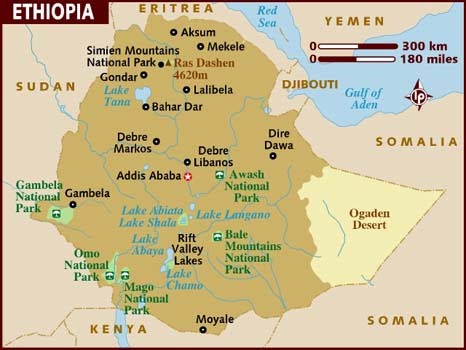
Ethiopia


Disclaimer: Ethiopia is more full of history than I know what to do with. My apologies if I get carried away and get about as exciting as a text book. :)

My first exposure to Ethiopia was the roughly nine restaurants located on the same street in Washington DC, blocks from my old house. The food was good, which is of itself enough to convince me that I need to visit a place. But the food was representative of every other element of Ethiopian culture—it’s so unique. Ethiopia is Africa’s only country to have avoided colonization, and the language, religion, and traditions of the people have thrived in ways unlike in other African countries.

So when my friend and former co-worker from MCC, Stacy, told me she’d gotten her Peace Corps assignment there, I was quick to propose that I be her first visitor :) I debated leaving Cameroon for such a long vacation so near the end of my service. But while sitting comfortably boarded on the Ethiopian Airlines jet, leaving Cameroon for the first time in almost two years, a handsome Ethiopian flight attendant handed me my single-serving bottle of red wine with a warm smile, and I felt confident in my decision.

Upon arriving, I almost immediately noticed what seemed a striking similarity with Haiti—the patriotism and pride of being a one-of-a-kind country, with its own language, and a history of the underdog winning, battling off the colonial powers. Cameroon of course has its history, but it, like about 15 other West African countries, uses French as an official language. Yet as exciting as Ethiopia’s singularity makes it, I realized in talking to Ethiopia PCVs just what a struggle the language barrier is. The main language is Amharic. That’s like what Jesus spoke. I can hardly imagine. The script has over 200 characters, in an array of attractive squiggles and loops that sometimes remind me of dancing people. Attractive squiggles aside, you basically arrive in country and are immediately and totally reduced to illiteracy. In the case of Ethiopia, that pride and patriotism in being a one-of-a-kind country comes at the price of very difficult communications.


And so the tour begins! (For your viewing enjoyment )


My three weeks in Ethiopia began at Lake Tana. It’s the source of the Blue Nile River, and home to several centuries-old monasteries, dotting its shores and islands. Almost half of Ethiopians practice Ethiopian Orthodox Christianity. Ethiopia was the second nation in the world, after only Armenia, to declare Christianity as its official state religion. The Ethiopians I observed were incredibly devout, kissing crosses or church walls they passed. They celebrate a slew of Saints, even more than the Catholics, I think, and adhere strictly to several dietary rules and periods of fasting. One 15th-century Ethiopian king, Zara Yacob, actually required his subjects to tattoo “I renounce the accursed, I am the slave of Mary, mother of the Creator of the universe,” on their left arms, “I deny the devil,” on their right arms, and a crucifix onto their foreheads. That was the 15th century, but I still saw some crucifix forehead tattoos during my trip!

It took almost three hours to reach the monastery of Narga Selassie, on an island in the middle of Lake Tana. Several of the most remote monasteries are “too holy” for women to even enter. This also includes female animals. Keep the hens, pigs, and girl goats away!


Orthodox churches are often round. In the center of each church is “the holy of holies,” a replica of the Ark of the Covenant, built to house the Ten Commandments God gave to Moses. The Orthodox church believes that the original Ark is in the historic city of Axum. I believe Indiana Jones thinks otherwise.


I was on a puttery motorboat on Lake Tana, but the locals typically use canoes made out of papyrus reeds. (That’s the same stuff Egyptians used to use to make paper!) The canoes are so strong they sometimes carry oxen from one village to another. In many ways, life there seems to have remained unchanged throughout centuries of planting and harvesting.


From Lake Tana I traipsed further north to Gonder, a city oozing history, but also comfort and charm. I also drank so many macchiatos in Gonder as to ooze caffeine from my every pore. No wonder I liked that city so much.

The history quickie:
Several Ethiopian Emperors lived in Gonder, starting with King Fasilades in the 1600s. While Gonder served as Ethiopia’s capital, the Emperors built several castles, influenced by a mix of Indian, Portuguese and Moorish styles. The castles sustained heavy damages when the British bombed the Italians who had taken up residence there in the 1930’s, but are still fascinating and largely well-preserved. History complete.

Fasilades’ castle


Gonder is known as “Africa’s Camelot!”


Also in Gonder, I visited the church of Debre Birhan Selassie, built by one of the Emperors in the late 1600’s. Ethiopians LOVE St. George. He is killing his dragon in every church in that country.


You can also find St. George here, with dead dragon:


But back to Debre Birhan Selassie. The artwork covers every possible inch of space, depicting scenes from the old and new testaments, along with other legends of the Ethiopian Orthodox church. I don’t know this legend, but in case you were thinking of misbehaving, think again:


From the ceiling, hundreds of little angels peer down.


The typical cross that adorns the exterior of Ethiopian churches


And now, a modern charm?


My favorite restaurant in Gonder. Satisfaction guaranteed every time.


And randomly, I caught a political parade in Gonder! Presidential elections are later this month. I could hardly cross the street for an hour.


From Gonder, it was northwest into the Simien Mountains. I teamed up with a lovely German girl to split the costs of the hike. We were joined by the noble Mohamed, our rifle-toting scout (park’s requirement!) who guided and protected us. He did a fabulous job, especially given that during our three challenging days and nights together we had but three words in a common language to rely on. He looked at least 60 years old and had legs about as skinny as my arms. In the mountains at night it was so brutally cold. I wore a sweatshirt and jacket borrowed from another PCV, the only sweater I own in Cameroon, a blanket draped around me, and my scarf tied around my head like a babushka. Wearing all the aforementioned clothes, I slept in a ball at the bottom of my sleeping bag, about as close to the German girl as you can get away with for having just met someone earlier that week. After cooking the last night Mohamed could tell how cold I was and took my hands to warm them up in a kind, grandfatherly gesture. (It was not creepy, there were 18 other people around!)

The mountains:


Does Mohamed know he is my favorite mountain man model?


The Gelada Baboons are indigenous to Ethiopia. When Mohamed would see them, he’d cry out excitedly “Baboosh! Baboosh!!” and point in their direction. Incidentally, this is also the French word for flip-flops.


My favorite view, like a dramatic curtain of rock.


Last looks at the mountains. I’m really motivated to see the Grand Canyon now and see how it compares!


I climbed to a new personal height, 13,350 feet! You feel so far removed at such heights, and I’m always surprised to see any one else there, although usually only small herder boys. You really feel like you’re on the top edge of the earth—the only direction you can see is down. You’re above the tree-line too so you see vast, bare space. The ride just to get out to the Simiens had been so long I’d already felt like I was at the end of the earth…

From the remote Simiens north to Axum, an even more remote, dusty town in the far north of the country. It once served as a major crossroads for traders on their way to the Red Sea and farther yet to the Arabian Peninsula. It was one of the most powerful cities of the region in the 4th century, and its kingdom stretched into what is now Saudi Arabia. The location that once made the town great now seems a plague. The border with Eritrea to the north—and access to the Red Sea—has been closed for ten years due to these countries’ conflict. Arriving in Axum now, you’re at the end of the road, discovering what feels like a lost secret.


Before the arrival of Christianity in the 4th century, rulers of Axum were buried with huge granite stele as grave markers. No one really knows how they were erected—the largest one still standing is 78 feet high! Many are carved to look like multi-story houses, complete with little doors. (As demonstrated by my guide!)


The largest stele, at almost 110 feet, is believed to have fallen while being erected. It’s been left for some 1500 years, lying undisturbed where it crashed into pieces.


The Italians swiped one of Axum’s biggest stele in the 1930’s, to erect it in a main piazza in Rome. It was restored to Ethiopia in 2005 but this sign was a consolation prize while Ethiopia was still waiting to get the stele back…


I liked the bright artwork of this church near the stele field.


And then Christianity arrived in Axum. No more stele, but the here comes the Ark of the Covenant! Legend says that it was King Menelik, the son of Solomon and the Queen of Sheba, who brought the Ark to Ethiopia. The Ark is legendarily an oracle, helps the Ethiopians to win battles, and causes anyone who sees it to burst into flame. It’s kept here, in the chapel of St. Maryum of Zion, in Axum. The chapel is a major site of pilgrimage for the Ethiopian Orthodox.


If you’re not churched out, one site outdid them all: the rock-hewn churches of Lalibela. What the heck is rock-hewn? Instead of building churches from the ground up, the Ethiopians of the 12th and 13th centuries decided to dig the churches out of rock, and starting from the top down, they carved into solid stone.

I could feel through my socks the cool uneven rock floors of the sanctuaries. I asked our guide why all the walls and ceilings were so perfectly smooth but the floors were so bumpy. The guide answered erosion. I could only imagine the centuries of priests and pilgrims, solemnly shuffling through there before me, as we each leave a little mark for the others’ feet to feel.


Because the churches are carved into the ground, they are surrounded by deep trenches, allowing only a little sunlight in, and making them feel that much further removed from reality. Our guide took my camera into one room where we were not allowed as women, where larger-than-life-sized saints were carved into the rock walls—cool! Me, Stacy, and Saint.


And we meet our friend St. George (or Giyorgis) again!


The view from the top of St. George’s church…


the side…


and below… all one enormous piece of stone.


And there are eleven such churches in Lalibela!

The priests also seemed as though from another time, displaying the centuries-old processional crosses. The colorful umbrellas? A more modern touch.


The priest of St. Georges’ church rests. To the right, George is on his horse.


After seeing more churches in a week than I’ve seen in two years of Peace Corps, I headed south towards the Rift Valley lakes, where a ton of PCVs planned to compete in a 7k run. It was great fun to be surrounded and supported by so many others and to compete—I forgot how much I love and hate competition at the same time! (Mostly hating how terrible I felt during the last mile of the run...) There was actually an “elite” category for the Ethiopians, maybe to help us foreigners maintain a morsel of our dignity. Watching them run was beautiful. They were all a least a head shorter than me, tiny in every aspect, and they make running look so easy. I felt like I was watching an Olympic event.

So running alone that day would have been enough to do me in. Drinking the amount of tej I choose to drink that day would also have made for a rough day-after. Alas, being the champion that I am, I did both. Tej is the local honey wine. In a moment that felt entirely Peace Corps, about ten of us PCVs went to the local tej shack to fill up our empty water bottles. An eight year old filled our waiting bottles with the thick golden colored elixir, as old Ethiopian men drank and looked on curiously. Two liters of wine cost less than a dollar. I got my money’s worth. Nothing like boozing with the locals to make you feel integrated!

A few other Ethiopian observations/highlights:
Pukemobiles.
I don’t know if it is a national trait, but holy geez I have never seen so many people lose their lunch in one day as I saw in Ethiopia. It wasn’t just lunch: add breakfast and dinner. Stacy and I counted 6 pukers for a total of 18 pukes in about 10 hours. (Now I know you want to come to Ethiopia!! That is one puke every 33 minutes of traveling bliss.) I have many theories: the injera, or fermented pancake that is the national staple, might not sit so easily on the belly. The strong, rank odor of goat meat also doesn’t inspire digestion. Add to those the windy mountain roads leading south towards Addis Ababa. Seriously, the busses even keep little plastic baggies so you can puke in those, tie it up and give it to a friend! We hadn’t been driving for fifteen minutes, in the pre-dawn haze I could hardly see what was going on, when the guy sitting directly next to me just unabashedly lost it all over. Then he wiped his mouth on the bus’s window curtain. Ewww. I got really cozy close to Stacy on that ride! I will praise Cameroon’s straight northern roads until I leave this country!!

My pants.
This is a highlight of my time in Ethiopia because I’m sure that many of my friends and relatives would celebrate the passing of my famous brown pants. I was in the Ethiopian Ethnological museum with a fellow PCV I’d only recently met, and was reading about the Ethiopian Jews and Muslims and whatnot. My pants zipper has been faulty for some time, in that it self-descends… so I just calmly and hopefully subtly regularly zip it back up. As I was reading about the Ethiopian Jews, I become convinced that if I just give a firm enough tug, maybe my zipper will stay hoisted once and for all. Umph! And I am left holding my zipper in my hand... far from its home on my pants. That wouldn’t be a problem, except my pants will fall down cause this zipper does not stay zipped. Fortunately for me, I have been in Africa for nearly two years now and nearly everything I own is falling apart, so I borrow some safety pins from my also zipper-busted wallet, and secure my pants. Crises averted. At the end of our museum tour, my new friend announces he’ll swing by the restroom on our way out. Great idea! Oh wait. I can’t. I am a captive in my pants. Once I take those pins out and undo the zipper, there’s no refastening to be had. That zipper can’t go back up. (And it is a long zipper, that would show much scandal if left to flap open in the breeze like a proud Ethiopian flag.) We had a long and busy day planned for ourselves and so I wait… and wait… and wait, til I can gently retire my brown pants at the hotel, taking them off once and for all. (Actually, although I know you would all prefer to hear that Brown Pants will be resting in Peace, it is not so. They are at the tailor’s now, awaiting a new zipper, and a new lease on life!) Morale: always have an escape plan… from your pants.

Rastafarians:
Another highlight was seeing where the Jamaicans who find their way to Ethiopia to practice Rastafarianism go. I stopped at one of their churches with my new PCV friend from the Pants Incident, so we could ask a few questions. We tried one old Jamaican, but he was so stoned that absolutely no communication was passable. I think our man could have been a poster boy for 60 straight years of smoking pot: here’s what you get! In my quest to communicate, first I slowed my English down, given that we have different accents. Then I eliminated all non-essential articles and adjectives. Then I really break it down, “You… arrive… Ethiopia… when?” “Jamaaaaican…” he answers. This is going nowhere fast. Another more coherent Rastafarian comes along is more capable of answering our questions. In case you are wondering, they smoke pot because it better helps them commune with God. They wear dreadlocks because scissors are unnatural and back in the day, no one had scissors. I was required to wear a curtain on my head (a recurring theme in foreign churches?) for propriety’s sake. And Haile Selassie, former emperor of Ethiopia is God. Not a representation, but he is God, and the fulfillment of a biblical prophecy that says kings will come out of Africa. A tenant of the faith is that African descendants come home to Africa, namely Ethiopia, the birthplace of humanity.

The Rastafarian hub is a town called Shashemene. Oddly, although Haile Selassie is considered God, he practiced not the Rastafarianism that gave him his deity, but Ethiopian Orthodoxy (quelle surprise!) Selassie did, however, grant the Rastafarians 500 hectares of land so they could cultivate and live in peace in Shashemane. The modern day relations between the Rastafarians, and Ethiopian Orthodox don’t seem fantastic. Namely, why did the Rastafarians receive all this land when no Ethiopian is allowed to own land? (All property is government-owned.) It was all quite interesting for me, and now I’d love to head to Jamaica and see some of these ideas in practice. Also interestingly, I heard Bob Marley converted to Ethiopian Orthodoxy at the end of his life.

Crackdown on free speech:
I apologize for the long silence while I was there! At first I thought the internet connections were so terribly slow that I couldn’t open my blog. It wasn’t until later that the other PCVs informed me that the government has completely blocked access to blogspot. It was an eye-opening reminder that we don’t all get the same freedoms of the press. Ethiopia has presidential elections this month, and the PCVs expect that all phone services will be completely cut by the one government-run cellular provider, in an effort to control and keep people in the dark—yipes!!

A National Icon
Although free speech gets the crack down, Condom Man is on the loose. He is every where! Cafes, handbags, T-shirts, and hanging out in our hotel room here in Addis Ababa!


Sweet people
At a fancy bar in Addis, I spent my last night with a great group. Here are friends old and new, Stacy, Barack, and Haley. They made visiting Ethiopia awesome!!


So to wrap up, I’ve actually never been to a country where I knew so little of the language, or was completely on my own! (Stacy and I only met up 12 days in!) At the same time it was intimidating, I’m glad I did it—it was a little push outside my comfort zone that did a body good. Now it’s making me think of all the other places I’d like to go and maybe just hadn’t dared to venture into all alone (sorry Mom and Dad! :) Seeing Stacy was wonderfully refreshing to be able to talk about our former DC life, catch up on office gossip, and share tidbits and understand the current Peace Corps life, albeit in countries across the continent.

Alors, back to Cameroon!